When a competitor publishes a new case study, the useful question is not only "what changed?" It is which industry, company size, buyer role, problem, result, and proof format the competitor is making more visible.
This guide explains how to monitor competitor case studies, reviews, customer-logo sections, and related announcements, then turn those changes into practical decisions about segment focus, landing pages, campaigns, and sales material.
The short answer: read customer proof through five fields
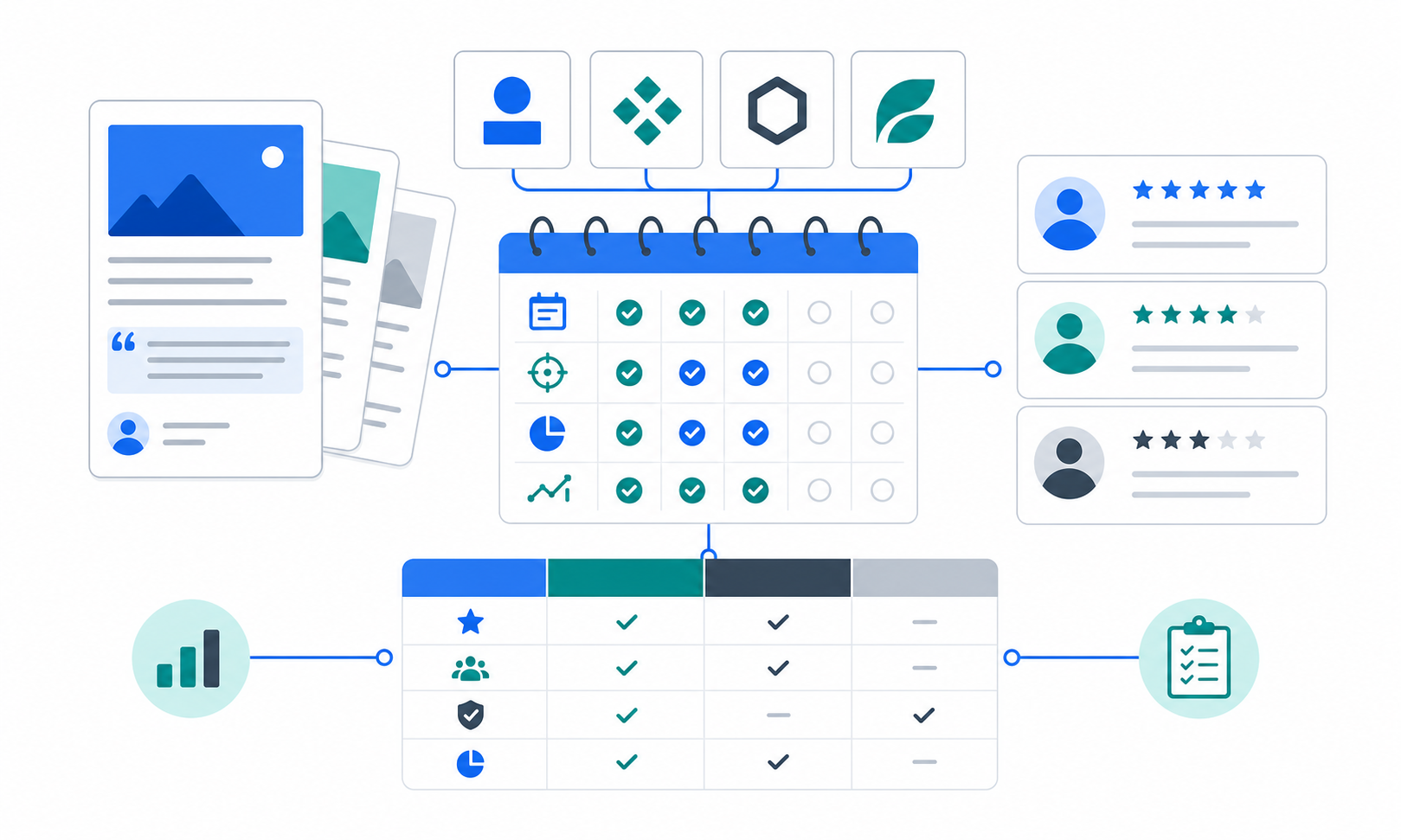
Use five fields when comparing competitor customer proof over time:
- Segment: industry, company size, and region
- Role: the buyer, user, or quoted stakeholder
- Problem: the before-state or trigger
- Outcome: the change the story claims
- Proof type: case study, review, customer logo, quote, number, or announcement
Do not treat one case study as proof of a market shift. Treat it as a signal when several stories point to the same segment, reviews repeat the same problem, or the proof aligns with a homepage, product-page, or pricing change.
Why customer proof deserves its own monitoring workflow
B2B buyers increasingly research before they contact sales. In April 2026, G2 reported that 51% of B2B software buyers were starting research with AI chatbots more often than with Google, and that review-site citations were a major trust signal inside AI-generated answers.
Other 2026 buyer research points in the same direction: buyers want substance, useful proof, and clear evidence that a vendor understands their situation. That makes competitor customer proof more than PR. It shows which buyer profile a competitor is trying to make credible.
References:
- G2: The Answer Economy research announcement
- Arcade: What Today's B2B Buyers Actually Trust
- INFUSE: Voice of the Buyer 2026
Step 1: separate the proof sources by job
Monitoring the entire competitor website as one source creates noise. Start with the pages that carry customer evidence.
| Source | What to capture | What it can help decide |
|---|---|---|
| Case-study library | new stories, industry tags, company size, department | which segment the competitor is building proof for |
| Individual case study | previous problem, reason for choosing, result, quoted role | which pain points sales may be targeting |
| Customer-logo section | added logos, ordering, grouping | which customer category the company wants visitors to notice |
| Review sites | repeated praise, complaints, use cases | how real users describe strengths and gaps |
| Press releases | adoption announcements, joint launches, named customers | which customers may become public proof later |
Stratum Flow supports one Seed URL per job. Use separate jobs for the case-study library, review page, or press-release page when the extraction question differs. The Seed URLs guide explains the setup.
Step 2: create the first customer-proof baseline
You cannot detect a meaningful change until you know the starting point. For one competitor, capture the current customer proof in a compact baseline.
| Field | What to record | Example |
|---|---|---|
| Segment | industry, company size, region | enterprise manufacturers in North America |
| Role | quoted person or implied buyer | CIO, RevOps leader, head of product marketing |
| Problem | before-state or buying trigger | manual reporting, slow approvals |
| Outcome | result framing | monthly reporting became a weekly review |
| Proof type | format of the evidence | case study, review, customer logo |
| Source | URL, review date, screenshot location | checked June 28, 2026 |
Do not archive every sentence. Keep the fields that make week-over-week comparison possible. If a quote or number may be useful in sales material, preserve the source URL and review date.
Step 3: classify the change before interpreting it
A new case study does not automatically mean a new strategy. Classify what changed first.
| Change type | Example | First check |
|---|---|---|
| Segment shift | several healthcare, financial, or manufacturing stories appear | do landing pages or ads emphasize the same vertical? |
| Role shift | the quoted buyer changes from IT to marketing or operations | do product pages name the same role? |
| Problem shift | the story moves from cost savings to risk management | do pricing, security, or compliance pages support the move? |
| Outcome shift | the result framing moves from time saved to revenue impact | should sales comparison language change? |
| Proof strength | named logos, metrics, or third-party reviews increase | does your own proof library now look thin? |
This structure moves the discussion from "they published something" to "which internal decision might this affect?"
Step 4: write research instructions for proof, not volume
Customer-proof monitoring should not optimize for the number of detected updates. The goal is to identify which buyer and which decision the proof supports.
Case-study library instruction
Identify new or updated case studies. Return industry, company size, region, buyer role, previous problem, stated outcome, proof type, and source URL in a table. Ignore layout-only changes.
Individual case-study instruction
Extract the buyer problem, reason for choosing the product, outcome, quoted role, and any language likely to be reused in sales material. Separate observed facts from hypotheses, and mark any inference as a possibility.
Review-site instruction
Summarize repeated praise, repeated complaints, and common use cases from recent reviews. Do not quote long review text. Return trend, evidence URL, and review date.
Use How to Write Effective Research Instructions to make the output format, exclusions, and inference rules explicit.
Step 5: convert the finding into your own review question
Raw customer-proof changes rarely create action on their own. A weekly note should connect the observation to a decision your team may need to review.
| Observed change | Working hypothesis | Internal review question |
|---|---|---|
| Competitor A added three financial-services case studies | the team may be increasing focus on financial buyers | do our landing pages have enough financial-services proof? |
| Reviews for competitor B repeatedly mention fast implementation | implementation speed may be a perceived strength | can sales explain our implementation path clearly enough? |
| Competitor C reorganized logos by company size | enterprise credibility may be getting more emphasis | should our comparison deck update trust proof? |
The right response is not to copy the competitor. Use the signal to check your own strengths, proof gaps, customer base, and active deals.
Weekly review template
Competitor:
Customer proof changed:
Segment / Role / Problem / Outcome:
Proof type:
Evidence URL:
Working hypothesis:
Internal question:
Owner:
Next check:
This format lets marketing, sales, and product teams discuss the same evidence without collapsing facts and interpretation. If you route findings into Slack or Teams, include these fields in the report output before configuring delivery. The Webhook setup guide covers notification destinations.
Common pitfalls
1. Counting stories instead of reading the pattern
More case studies do not automatically mean a stronger market signal. Look for repeated segments, repeated problems, or repeated outcome language.
2. Treating the competitor's customer profile as your target
A competitor may be moving toward financial services, enterprise accounts, or a new role. That does not mean your team should follow. Compare the signal with your own win rates, onboarding difficulty, and customer evidence.
3. Overweighting one review
Reviews are useful, but one complaint or one compliment can distort the picture. Look for repetition across several reviews, customer stories, and product-page changes.
4. Losing the evidence date
Customer proof changes over time. Keep the review date, target URL, and screenshot location so future discussions can reconstruct what was visible.
How to start in Stratum Flow
Start with one competitor's case-study library.
- Create one job with the case-study library as its Seed URL
- Require Segment / Role / Problem / Outcome / Proof type in the research instruction
- Check the first report's source URLs and extraction fields
- Review only new or updated customer proof each week
- Escalate important changes to Slack, Teams, or a weekly brief
Use the dashboard setup guide to create the first job. Once the output is stable, add review sites, press releases, and customer-logo sections.
Summary
Competitor customer-proof monitoring is not about collecting every new case study. It is about seeing which buyer profile a competitor is making more credible. When you record Segment, Role, Problem, Outcome, and Proof type consistently, the signal becomes useful for landing pages, sales material, and content planning.
Next step
Try Stratum Flow free and start monitoring customer proof